Showing posts with label Features. Show all posts

Friday, November 03, 2006

TIKIM: COOKBOOK KITCHEN

Along the streets of Socorro Fernandez, intersecting Torres St. in Mandaluyong, you will find a cozy restaurant called the Cookbook Kitchen. I found this place with the help of my friend, Cielo, whose tita owns the place. The semblance of a local painter’s version of Vincent Van Gogh‘s Café Terrace at Night complements the well-ventilated and well-lit room. Capacity is at 40 to 50 seats, ideal for intimate gatherings for family and friends. It’s also good for a warm get-together with significant others and colleagues.

The Cookbook Kitchen offers delectable Italian cuisine just right to the Filipino taste. Not only does it cater to our native tongue but also to our thriving budget. Appetizers range from Php 88.00 to Php 100.00 with pasta dishes amounting between Php 180.00 to Php 220.00. They also have rice meals for heavy eaters – chicken, sausage, pork and fish dishes priced from Php 180.00 to Php 260.00. Desserts are also offered for those with the sweet tooth, from ice-cream to cakes.

Must try is the Parmesan-crusted White Fish at Php 240.00, which is good for two. The fish is very tasty as it is served on an oven-baked dish plate complemented by the steamed rice.

What is also nice about the place is the service provided by the staff who are always smiling and welcoming. You can also get a free palm reading when Cookbook Kitchen is not that busy. Just ask for one of the staff, Teta, who can give you her own interpretations of your fate or luck.


Dessert samplers: To die for

So next time you visit Mandaluyong or if you are craving for Italian food, go visit Cookbook Kitchen. They are open from Mondays to Sundays, 10 am to 2 pm and 5 pm to 10 pm. Enjoy the food because I sure did!

Our rating (5/5):
3.5 for Taste
3 for Ambiance
3.5 for Customer Service

_________
Deng Perez is HDI's Quality Management Manager.

Wednesday, October 25, 2006

ESSAY: AT THE END OF THE TUNNEL

by Hermie Solemino

The journey we are trekking is indeed very long. From life's many avenues, we often pause and wonder how far we've moved on, or maybe we are just wandering in the labyrinth of a vicious cycle, stagnated and held down by many unnecessary worries that cling to us even in our deathbed.

How often do we wonder how big the universe is and how small and minute we are compared to it. The most beautiful, the wealthiest, the most powerful, even the most educated...an array of hyperbole and exaggerated adjectives that never stop, carved and propelled by man's vain imagination and self pride that he endowed himself out of narcissism and arrogance. Ah! Man, oh Man!


At the end of the tunnel...the most profound personal experience anyone can have was the beautiful journey of Rio Diaz Cojuangco. We are at all times frowning on the morbid idea of death, hanging on even to the last speck of hope, to cling on to the life so dear to us. In my solitude, I pondered how beautiful this lady is, not because she is physically pretty but more so because she went out of the basket and found her way to reconcile with our Creator. Rio Diaz Cojuangco, the former beauty queen, the actress, the politician, wife of the son of one of the wealthiest men in the land - she's got it all and yet she artfully and selflessly stripped herself of so many accolades and looked at herself vis-a-vis the spectra of the entire universe, to find out she's nothing compared to the vastness of it much more to the Omnipotent Hand that created it. She traversed her journey, touching people's lives even at the midst of man's most feared anguish called cancer or “Big C” by those who are enlightened and not so enlightened terminally ill patients. Others look at it as a curse, but Rio found blessings in it. She found herself and found God in it. That was far more better than any medicine and cure she received from one of the most elite hospitals in the United States.

I was even more amazed at how great the strength she showed, concerning herself more on how to console her loved ones than herself. People seemed to notice the real beauty that glows in her and yet she never claimed the glory but offered them to God - very selfless! She quoted what mother Theresa of Calcutta once said, “The donkey never did think that the honor and the glory lavished by people during the Feast of the Palm and the victorious entry to Jerusalem was his but to Jesus who was riding on him!”

We can never magnify the whole picture unless we dare to be little and humble. Our self-centeredness blurs our vision of the truth. Her life was a truth for the King of Truth, a living witness that is too fierce as to engulf us in the mystery of God's profound love for us. Until now, she is knocking to open our eyes and see ourselves go squarely beyond the assorted ornaments of the body.

We sojourn and yet it is a journey of limits. We travel on a road we ourselves paved, unguided by the Mighty Engineer who knows us even before we are conceived, the Most High who wanted to tell us that we exist not by accident but by His love. We may have problems like sicknesses and tragedies and we ask Him so many questions, only to lose hope and consequently curse Him. That language is far beyond man's understanding and yet God never see these personal tragedies as curses but as blessings, that he intended these to happen because far more important are not the sicknesses and the weaknesses per se but the messages behind them. That we see these tragedies in the point of view of man's experiences and comprehension, that God's ways and means are distinct beyond the dimension of human understanding. But if we open our hearts and souls and blind our physical senses, there is so much we can discover far beyond human reason. After all, He moves differently from our ways. He moves in His own laws, divine and mysterious, that not even the brightest can grasp its substance.

Some say when you are about to meet the angel of death, there is that reckoning as you look back in time and images of your life flashes before your eyes, painting your vision in a vivid array of colors that defines and narrates your life. Will you spring back in fear and wish to turn back the hands of time? Or will you meet those memories with sweet smile in your face, when you can bade your last farewell with no regrets and resentment and extend your hand with your angel to take your last breath that leads you to the beginning of a whole new world. A world where after the thorny path you traveled, your road is covered with jasmines and hyacinths and roses and crimsons that perfume the air and blossom like they have opened in the early hour of spring waiting just for you while the sweet murmurs of the breeze gently caresses your face, unveiling you so that you can see the glory of God in all His majesty as He allows you to see His face which not a single mortal had seen. What a lavish prize you deserved after a life of pains and sufferings.

When a baby's first cry in the world is heard, we are all celebrating for a new beginning and yet we lament when the same baby ends his life after the end of his days. How short the journey is, how limited the time is, what a journey it has been. And yet in the middle of life we pretend to have seen eternity, holding every moment of it, forgetting the fact that as each leaf is wilting from the tree, time is also drifting and flows so fast like a river. We wake up one day and see our once jet black hair ashed and greyed by the passage of time. That no matter how hard we summon the technology of man, nature is still going through its natural course. That we can never bargain anything to stop the ticking of time, that it has come to pass as it should be. That pretty soon, we are going to let the divine destiny set its pace and we must submit to its wishes, then, we realize that nobody is indispensable, that nobody should live forever, that our end is not an illusion. Until we are only a piece of story in the whole gamut of humanity, a piece of story to tell..even this, fades to nothing as the generations after us follow.

How far can we go then, in this journey of life? We look back and there is Rio Diaz Cojuangco and you will see a very beautiful smile, that bubbly face that opened the eyes of millions and touched the lives of many. She said, and I quote “At the end of the tunnel, I would like to see my Lord telling me "WELL DONE MY GOOD AND FAITHFUL SERVANT!”

_____________________
Hermie Soleminio is from SPi Dumaguete. He is with Corporate HR.

SPipol: FACE TO FACE WITH ROGER RAMOS

by Espie Vitug and Perps Poblador

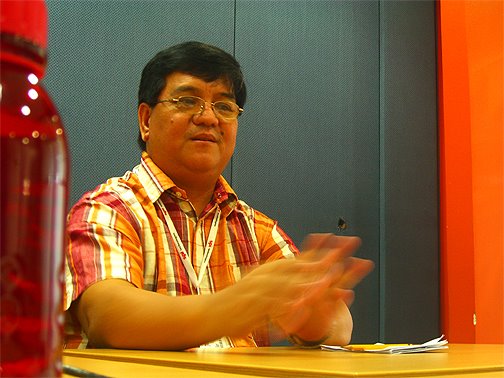
The man behind Employee Number 0002 is no doubt a legacy in SPi’s history. For the past 26 years, Roger Ramos has been one of the significant few who has seen SPi grow from a humble start-up company into a global enterprise. Yet more than that, Roger is also the man who had worked alongside SPi’s founder, Alan R. Fraser, whom he considers a supportive mentor and an affectionate friend. Surprisingly enough, Roger started his career in SPi as a janitor; he’s still proud to say that, with a gleaming smile to boot! More than the stories and urban legends he shared with us during those days in Saztec and SPI Technologies, Roger’s untold stories about his life’s challenges and successes are an even worthier read.

Starting Up

Roger Bohol Ramos is the eldest of 3 siblings. He was born in Manila in January of 1959 but grew up in Leyte. At 15, he was working in his grandfather’s farm when his grandmother advised him to go to Manila to take his chances at finding a better job. He then started working for a bakery in San Juan. In 1978, he moved to Gabcor Janitorial Services where he was an all-around janitor.

Early on, one can safely say that Roger was destined to work with the top bosses. His first janitorial stint started in the Director’s office of Don Bosco Makati. In his almost 2 years there, he had no absences, no periods of tardiness, and no reprimands were ever issued to him. Says Roger, "My boss admired my exemplary cleaning work!"

Eventually, he transferred to the Commodore’s office at the Philippine Navy headquarters. In January of 1980, the time he was reassigned to Don Bosco, Lady Fate gave his life a twist. One of his co-worker was assigned to a company called Saztec which was then located in Buendia. Afraid of the requirement to speak English to a New Zealander boss, Roger’s friend turned down the offer. Upon hearing this, Roger, awestruck with the idea, immediately asked his supervisor to send him instead. His boss didn’t give a second thought and instantly asked Roger to take his cleaning materials with him and off they went to Buendia. It was then, at that point, that he felt scared.

Dealing With the Founder


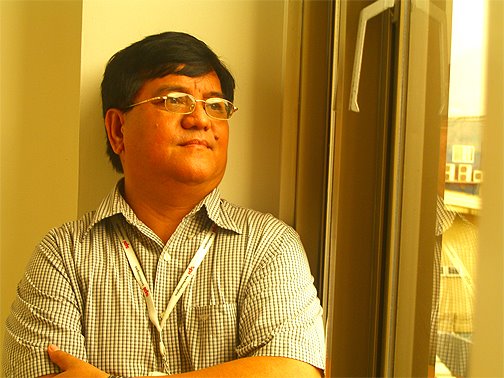
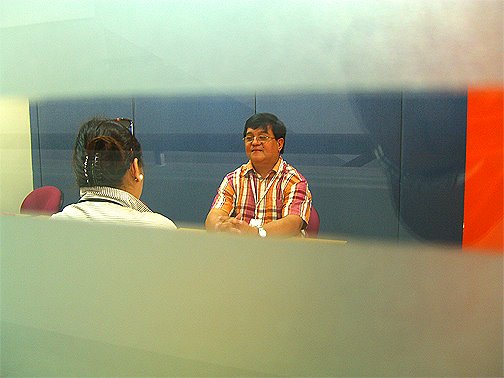
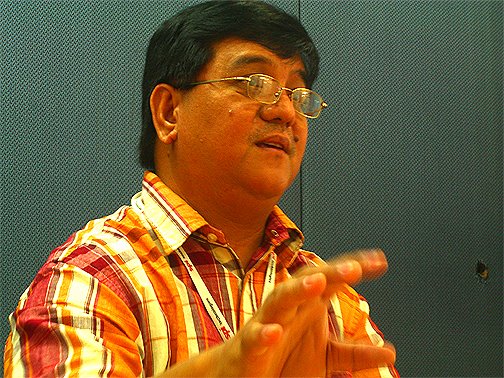
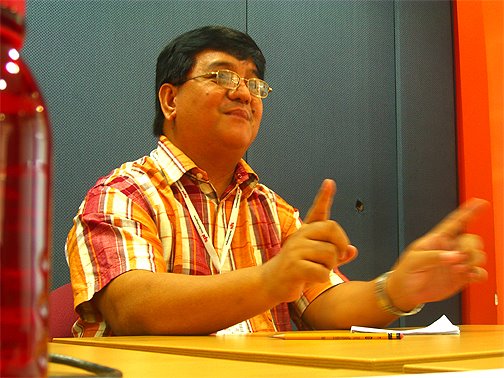
As a high school student, as a janitor at the Philippine Navy, at SPi's 25th Anniversary. Roger today.

Alan R. Fraser placed his arm over Roger’s shoulder, his sign of welcome to the man who’d turned out to be special to him later on. For Roger, he considered that moment a gift from God. Undeniably amazed with Roger’s dedication and attitude towards work, Mr. Fraser took him from the janitorial services agency to work for Saztec instead. By 1983, he was already promoted to Senior Clerk and was tasked to do administrative tasks and to supervise a new janitor who had replaced him. In 1985, he was promoted to Staff Assistant. He was one of SPi’s earliest HR employees who took care of the needs of employees by facilitating employment exams, benefits and conducting orientations.

Given many close encounters with Alan Fraser, we asked Roger how Mr. Fraser was as a boss. One thing he could describe Mr. Fraser as is that he was a “people person”. Mr. Fraser used to greet employees when he passed by them, visit the production floor after just a few hours of stay in his room, talk to his people and give them some advice. He established the Alan Fraser Foundation, Inc. which supported hospitals and charity institutions, provided educational scholarships to underprivileged children, and persuaded his employees to share in this passion.


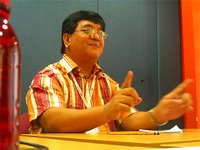

Roger had many fond and amusing memories of Alan Fraser. One particular instance was when Mr. Fraser was trying to teach Roger to speak English. Lucky for him, Roger had the confidence to converse in English with Mr. Fraser even if he would use hand gestures to help him express what he meant. Mr. Fraser, with his distinct New Zealander drawl, was known to speak really fast that it led Roger to misunderstand him many times. Once, he asked Roger to provide him 5 photocopies of a one-page document. Roger thought that Mr. Fraser was also asking for coffee but since he wasn’t sure about what he heard (he mistook “copy” as “coffee”), he didn’t do it. Instead, he made copies of the said document but made 20, paying the bill with his own money. When he got back, Mr. Fraser asked for only 5 copies. Embarrassed, he hid the excess 15 in the restroom supply cabinet. Funny enough, Mr. Fraser found them and advised Roger to ask him again next time he didn’t understand him, and paid Roger for the excess pages.

Mr. Fraser also advised Roger about English grammar, word usage and pronunciation. He even extended his help by sending off Roger to study English. With no chances of finding a good school near SPi, Mr. Fraser instead told him, “I’ll teach you English and you teach me Tagalog!" Roger replied, “I can do that, sir, but mine is Bisaya-style!”

Looking Forward

When the fifth floor of the SPi building used to be an unsheltered space, Roger used to stay there. He would always look up the skies staring at the planes passing over and say to himself, “Someday, I’ll get to be on one of those…” As a man full of wishes and desires, he was eventually able to go on trips abroad, get things he liked, support his siblings in their studies and meet his family’s basic needs, build his own house and invest in a business. Just this year, he achieved the distinction of being the top investor in SPi’s Cooperative.

His secret weapon?

"Putting God as a center of my life. I used to be a janitor and messenger before, going from one Makati building to another. I’d always tell myself that I’ll get inside these beautiful buildings someday. I made it. Never be discouraged. Continue to wish and strive to achieve those dreams. Darating din tayo doon.”, Roger advises.

Despite a colorful past with Saztec and SPI Technologies, he’s also happy to observe that SPi is on the right track and he’s satisfied with the way things are. There are a lot of improvements being made under ELC’s tutelage especially in the value of the services the company offers due to use of technology. With more exciting challenges ahead, Roger noted that the more it has become imperative for SPi people to unite, to support one another and to be dedicated.

As he recalled SPi’s culture in the past, employees used to be highly disciplined; unfortunately today, in many companies in the country, very few show gratitude and concern towards each other and towards their company. Somehow, the sense of ownership is no longer there.

"There is a need to go back to the basics." Roger said that emphasis should be placed on the 4 As which Alan Fraser himself conceived —Attitude, Attendance, Achievement and Accuracy. These guiding principles used to be followed during SPi’s early years but now has transformed into the core competencies of the present SPi. Roger also agrees that life today is tough, but he says that his life long ago was even tougher. The story of Papa Roge — as what his young, spirited colleagues would call him — doesn’t differ much with that of our talented and brilliant new generation of employees yet he also encourages everyone to maintain proper work ethics, which we’re oftentimes missing out today. He also added these simple advices: Show and do kind gestures to others. Smile. Go to work with a peace of mind. Manage your finances well. Save for the future.

All throughout the interview, we’ve been craving to ask Roger this question: After 26 years in SPi, why are you still staying here?

Without hesitation, he smiled and replied, “I love SPi now. It’s a gift from God to me."

Well said, Roger. Absolutely well said.



______________________________
Espie Vitug is an Executive Assistant and is currently the President of the Toastmasters Club of SPi.

Perps Poblador is currently the Operations Support Supervisor in SPi's Healthcare. Perps misses spending in long hours in the Hallmark cards section, eating Tootsie Roll, Magic Bee, Curly Tops, Lips and a certain sour candy (she couldn’t remember its name), playing patintero, Chinese garter and TEX, and shopping in Divisoria. Perps is now in search of her soul mate.

Photo credits: Dylan Gozum. Thanks to Roger Ramos for lending us his photos.

Tuesday, October 17, 2006

PERSONAL: SIESTA MADNESS


by Mahros Abaño

I don’t know if you would agree with me that the most noted Filipino tradition that is by far the most hated by any kid age 5 to 12, is the siesta. Okay, some do-gooder will raise his hand and say that siesta was a Spanish tradition and was just passed on to us Pinoys; then again, it as important as a Filipino quirk as say, calling toothpaste of any brand, Colgate.

When I was a kid, I absolutely hated siestas. I would prefer watching television rather than taking a nap. Since I went to a public elementary school, I only have classes in the morning. My grandmother and our yaya would be the ones watching my sister and I, since both of our parents work. So after I got my lunch and the final credits for Eat Bulaga (they still have credits streaming up the television then) appear on the screen, it could only mean one thing, its time to take a nap. My sister would immediately follow our yaya to our room. I surmise this was because she’s still a baby at that time.

Now, being the argumentative kid that I was, I never took it quite lightly. My grandmother, a feisty woman of Waray descent, never took to tantrums well. Every afternoon, neighbors would hear our arguments on the issue of my taking a nap. Our debates would usually sound like this:

“Ok, Eat Bulaga is now through. It’s time for you to sleep,” Lola would say.

“Can I just stay for Agila?” I would plea.

“No, you have to sleep now.”

“Could I stay until “Ang Nakaraan”?”

“No.”

“Why do we need to sleep?”

“It is because kids need to sleep to grow.”

“Can I just stay for Agila?”

“No.”

“Why don’t you take a nap as well?”

“When you grow old, you cannot get as much sleep as you wanted. So you go and sleep now.”

“Can I just stay for Agila?”

“No.” By this time, she would begin to stand and slowly walk to the kitchen. “If you don’t get to your room, I am coming back with the walis tingting.”

When this comes on cue, I would immediately run to my room. I would then feign sleeping for a few minutes but I keep my ears open as I listen intently as the theme song of the then-popular afternoon soap, Agila, was playing. As soon as the commercials were over, I would slowly stand up and pretend that I was sleeping for awhile and head for the living room.

By this time, my grandmother was usually sleeping on the sofa, but my yaya was usually up watching television. She would then begin the usual banter that usually sounds like this:

“Oi, oi, why are you up already?”

“Umm, I need to go to the bathroom.” I would say.

“Then go to the bathroom.”

“I’ll just watch until the commercial.”

“Ok, only after this commercial, ha. Your lola wants you to go to islip (she pronounces it that way).” My yaya is not as terse as my grandmother who was now snoring at the couch. By the third commercial (not necessarily always but jut in the middle of the program), my grandmother would stir and find me awake and watching television.

“Why are you up already?”

“I’m going to the bathroom.”

“Then go to the bathroom.” Unlike my yaya, she would watch and wait until I get into my room again. Usually, she would go back to sleep but there are times she would watch the programs. During these times that she would go back to sleep, I would again do my “going to the bathroom routine” to be able to watch TV.

After a few months, my parents got worried because my yaya told them I would go to the bathroom often. They took me to the doctor and had several tests. It was horrible. After that, I never tried that trick again.

Years later, my grandmother moved to my aunt’s house to help when aunt had my cousin. We also got a more lenient yaya who lets us watch TV and drink soft drinks in the afternoons until my father fired her because my sister got sick. After that, things got back to the same routine when my grandmother moved back in with us.

After my grandmother died two years ago, my sister and I were talking about how we tried to avoid taking siestas when we were kids. We laughed at how we tried all the palusot in the book just to not take them.

It was ironic that we are now clamoring for a few more minutes of sleep that as kids we totally threw away. I, for one, could now look back to those days with fondness, for they were not just fun times but times well spent with my grandmother; and bit of regret, because if I have just listened to my grandmother when she made me take siestas then, I should have been tall by now.


_____________________
Mahros Abaño is a part-time eccentric, full-time neurotic. She currently scratches her gray matter for the uses of punctuation marks she learned in elementary school as she is an English Editor for HDI. She is also on a Holy Grail pursuit for the best hopia on earth.

Painting: The Siesta, Vincent van Gogh

Friday, September 15, 2006

MUSIC REVIEW

Whatcha playin’, player?

by Mahros Abaño

With the fast-rising technology, CDs are practically becoming obsolete. Everything now comes in small, easily accessible packages, and how music is stored is one of them. I am not one to succumb to technology, being the technophobe that I am, but one has to yield to it. Eventually, I got my fat ass a player. It was like mixed-taping without the bulk. It gets me going in the morning, makes me pensive when in a long bus ride or just not make me scream bloody murder in the middle of Parañaque traffic at eight in the morning.

These are the tracks that I like listening to. I narrowed it down to my ten current listening, as I don’t want to take most of the space. Maybe you like some of them but even if you don’t, I don’t care a fig, just kidding. Share me yours, then. Here it goes:


1.) KOKOMO. The Beach Boys – I grew up listening to them but lived them much later. Brian Wilson can’t even surf even if his life depended on it, yet he wrote songs about surfing and hooking up with really hot, blond California girls. A true geek if there ever was one. It never fails to perk me up in the morning.


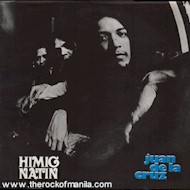
2.) HIMIG NATIN. Tropical Depression with Pepe Smith and Jr. Kilat – A collaboration of three of the best in the Philippine music industry one of the best songs ever written, and I am not mincing words here. I loved these three artists and I get tickled pink whenever I listen to this song. A good reggae rendition that any “rasta” worth his salt should have on his player.


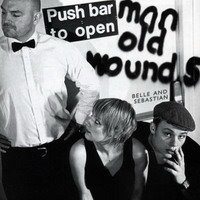
3.) IS IT WICKED NOT TO CARE? Belle and Sebastian – Isobel Campbell is one of the sweetest, haunting voices out there. As she sings the lines, “If ever there was a sequel,/Would you love me as an equal/Will you love me till I am dead?/Or is threesome else instead?/,” I cannot help but look out the window while on a long bus ride and contemplate the recent tragedy that is my love life. Best companion when I am in-an-indie-film type of mood.


4.) IN BETWEEN DAYS (Live). The Cure – Robert Smith. ‘Nuff Said.


5.) MARX AND ENGELS. Belle and Sebastian – I have tons of Belle and Sebastian tracks because I completely adore them and I have to recommend this. The piano part on this song is absolutely fantastic. This song is about a guy who is in love with a Marxist who wouldn’t talk to him unless it’s about politics; because of this, he could only watch her as she does her laundry.


6.) JULIE TEARJERKY. Eraserheads – I love them since I first heard them and this is one of the songs that show their maturity as musicians. I may be wrong, but there isn’t a single musician or music lover under the age of 30 in this country who was not influenced bu these guys.


7.) THIS USED TO BE MY PLAYGROUND. Madonna. I’ll admit it, I am a fag hag. And any self-respecting fag hag will have a Madonna track on her player, next to vogue-ing matches with her gays. Got to pay respects to the Madge.


8.) COIN-OPERATED BOY. The Dresden Dolls – This is a band composed of two freaks that dress up like mimes from a 1930s Berlin peep show and play this piano-laden track about getting a robot boyfriend after a bitter break-up.


9.) KING WITHOUT A CROWN. Matisyahu – He is an Orthodox Jew. He sings reggae, rap and does beat box. Watch your sexy back, Justin. With his inspirational lyrics about his devotion to God and other good things, coupled with kick ass beats, I’ll listen ti him anytime.


10.) I DON’T LIKE MONDAYS. Boomtown Rats – Admit it, who doesn’t? This song was inspired by a homicide in Britain; when the killer was asked why he shot a man, this was his reply. A funny ditty on a rather sad consequence of urban angst. So keep your hands to your coffee mugs, people, not on your gloc nines.

Again, I reiterate that this is my personal choice, si I wouldn’t want to hear a lot of reactions why this or that band is not included. If you like music and talks incessantly like I do, give me a shout out and let’s trade influences. E-mail me at sinister_teacher@yahoo.com.ph .


____________________________________________
Mahros Abaño is a part-time eccentric, full-time neurotic. She currently scratches her gray matter for the uses of punctuation marks she learned in elementary school as she is an English Editor for HDI. She is also on a Holy Grail pursuit for the best hopia on earth.

Thursday, August 24, 2006

REEL REVIEW (AUGUST 2006): KUBRADOR


Photo source: Wickipedia, probably by Boy Yñiguez (?)


SCREENPLAY: Joel Jover
CINEMATORAPHY: Roberto Yniguez
EDITING: Jay Halili
CAST: Gina Pareno, Soliman Cruz, Nanding Josef, Johnny Manahan, Jhong Del Rosario, Nico Antonio, Fonz Deza
PRODUCTION: Joji Alonso / MLR Films
MUSIC: Jerrold Tarog
DIRECTOR: Jeffrey Jeturian

One word immediately entered my mind when I saw this film: PANDEMONIUM. The clutter of shanties, the tight winding passageways that are littered with children, jobless men, and people who go about their lives as if it was meant to be lived the way it was depicted in the film – without direction, routinary, and full of fear and uncertainty.

The film revolves around the life of Amelita “Amy” Montemayor (Gina Pareño), a jueteng bet collector (“kubrador”). She leads a regular life but one full of risks. For someone in her position, this is exactly what “a regular life” means. Her day begins with a prayer to the saints and the Holy Virgin (“Sana hindi po ako mahuli ngayon.”), and after some shouting matches with members of her family, she goes out and does the routine of collecting bets and delivering them to the main collector, who brings these to a place where the winning numbers are chosen. Everything seems to be a study in contrast – some people are winners (a Wowowee segment show can be heard in the background), some are losers (the opening scene has another bet collector wearing an FPJ shirt that says, “Tuloy ang Laban!”).

The film opens and closes during All Saints Day – a mere three days in the life of Amy but full of luck (or misfortune, whichever comes first), accidental deaths, frustrations, dreams dashed to the ground, angst bursting at the seams. I am not surprised if people were either silently shedding tears or constantly shaking their heads in the comforting darkness of the theater. This is a film you wish to torture erring politicians with by making them watch it hours on end.

Kubrador is a well-thought piece of work although it tends to meander, rendering it too long and reducing its chances at getting an ending that is both effective and memorable. Most of its parts, however, are opportunities for self reflection because they are perplexing as they are tragic. As a society – and largely a Catholic one at that - it is a great wonder why we have allowed so many of our own people to be pushed against the wall and make them resort to risky means of getting a living. It would be interesting to find out the answers when we consider our own contributions as an individual – if there’s any, to begin with.

It’s not all sadness, by the way. In fact, Kubrador has it light moments. Despite the abject poverty, the family - and the sense of family – is still very much present. The funny moments are when Amy finds a numerical equivalent to every event or situation she finds herself into. Also, short appearances by some of the Philippines’ best theater actors – Soliman Cruz and Neil Ryan Sese (both appeared in “Ang Pagdadalaga ni Maximo Oliveros”) make for interesting viewing, and was that Gabby Eigenmann who was accidentally (and fatally) shot during a street altercation at the North Manila Cemetery? Gina Pareño, of course, is exceptional. She remains to be one of our underrated and oft ignored best actresses.

I read somewhere that Kubrador was the first film to be given an A rating by the Cinema Evaluation Board this year. How this will help the film at the tills is still questionable as most films given an A rating last year were commercial flops. The purist may assail me for wanting these films to do well commercially, but my intention is pure and simple: a commercial success means better chances of getting the film’s message across. And Kubrador’s message is important because it involves a life – or lives – that call for, and need help.

If anything, I got out of the movie house feeling a lot heavier – on the shoulders, I mean. While walking out of the quiet mall, the thought of Picasso’s
Guernica briefly entered my mind. This work features the impact of war on people. Mixed emotions, mostly of fear and anxiety, is written all over the subjects’ faces, but no one notices that on the bottom portion of the painting, a symbol of hope – a small flower – tries its best to emerge from the ensuing confusion and disorder.

I wish and pray for the same for Amy and the rest of us who fight our own little wars everyday. And that’s something I’d definitely put my bet on.

_____________________
DYG, current Writers Guild President, used to be a film reviewer for Yehey!

For more reviews, read
here. See the official KUBRADOR blog and website here.

Monday, July 31, 2006

CULTURE EXPRESS


Busy with work and have no time to explore the city? Visit GUTS. GRIT. GUMPTION. and get your daily photo dose of buildings (old and new), dining places (what's hot, what's not?), and more! Come and explore the City of Our Affections - Manila - through the lens of the Guild President Dylan Yap Gozum.

Note: Photos were sharpened for dull monitors.

Sunday, July 16, 2006

DA VINCI CODE (2006)

REEL REVIEW
by
DYG


I came, I saw, and I wasn’t conquered.

I will give it to you straight. The film version of the Da Vinci Code was a disaster, burdened by a brewing controversy of its own making (which, thankfully, helped it at the tills), and a ho-hum performance by its lead characters.


Directed by Ron Howard (A Beautiful Mind, M*A*S*H) and screenplay by Akiva Goldsman (producer of Poseidon, Mr. & Mrs. Smith, Constantine), the film successfully wasted the amazing sceneries of Paris and London by its irritating in-your-face photography. With the rare distinction of actually filming in all the locations found in the novel save for anything within the Holy See’s jurisdiction, there weren’t enough long shots of the Louvre and of the normally-breathtaking English countryside to provide a sense of grandeur, and the shots in the churches were given to trivial details instead of taking in their vastness, majesty – and emptiness - to capture the mystery that is most essential in this film’s success. After all, this is the very same thing that made the novel a winner. It has set fire to its readers’ imaginations, that to see the film version would be the next best thing to seeing the places mentioned in it.

But lo and behold, Ron Howard failed miserably in capturing the essence of the book. He focused too much on the controversial parts of the book (for obvious reasons) that he forgot that the novel was, first and foremost, a cultural trip across Old Europe’s most secret and mysterious locations. The controversial twists were merely that – twists.

The film also tried to end itself on an emotional and triumphant note, with a realization by Robert Langdon that Mary Magdalene was actually buried beneath I.M. Pei’s (in)famous glass pyramids at the Louvre. For those who’ve read the book, this is a new and totally different ending, but it only appears like an afterthought if only to close all the issues it raised during the length of the film.


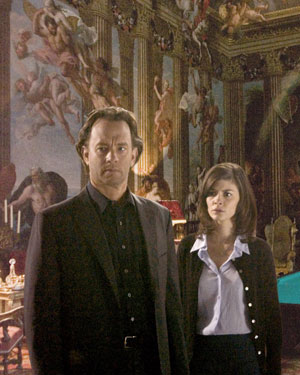
Needless to say (but I’m still saying it), Tom Hanks is wrong for the character of Langdon. He doesn’t have gravitas to live up to Langdon’s reputation. Audrey Tautou is a pretty and swell actress as exemplified by the global success of Le Fabuleux destin d'Amélie Poulain , but she appears staid and restrained in the Da Vinci Code. It must be because she has to speak in English, although this hasn’t been much of a problem with French actresses Sophie Marceau and Julie Delpy. Maybe she’d get used to it soon enough to be able to accept more English-speaking roles. (Note: a little-known film, Dirty Pretty Things, where she plays an illegal immigrant working as a chamber maid, is a must-see for fans and cineastes)

French films are to blame for this because they are rarely shown outside Europe – and available DVDs are almost always without English subtitles. Tautou’s last film, A Very Long Engagement, obviously was shown in Manila to cash in on people’s happy memories of her in Amelie, but I digress.

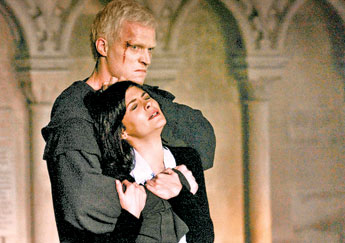
Sir Ian McKellen, playing the role of ‘The Teacher’, is the only winner in this film. Being English helps, I guess. French actor Jean Reno has done far better roles than this one. Léon comes to mind easily. Paul Bettany (Dogville, Wimbledon, A Beautiful Mind) as Silas is threatening enough but he could have given the role a little more oomph to incite fear, but I guess this wasn’t meant to be. He only went by the book, so to speak. Alfred Molina (Frida, Chocolat) as Bishop Aringarosa was forgettable.


Overall, the Da Vinci Code was a boring thriller sans the thrill. It wasn’t worth all the hullabaloo and I found myself in a semi-catatonic state all throughout. Well, just go on and see it; then, move on with your life.

Visit the official website
here.

Monday, June 12, 2006

CULTURE EXPRESS

Culture Express brings our readers from the staid environment of daily office life into the otherwise colorful world that we're sadly missing.

LA PIEL

Portraits by Marlon Despus
Running from Calendario
July 18 - August 31, 2006
18 de julio - 31 de agosto de 2006
Schedule Horario
Tuesday to Saturday, 10 am - 7 pm
Martes a sabado, 10 am - 7 pm
Venue: Sala, Instituto Cervantes Gallery

Fil-American photographer Marlon Despus has been trying to capture people's souls by portraying their skin. Marlon Despus was born in the Philippines of Ilongo and Ivatan heritage. He is a graduate of the University of California at Berkeley where he studied architecture, science, poetry, and where he was trained in photography almost thirty years ago.

Collecting images for this exhibit began in 2005 with the gracious support from a host of volunteers -- including doctors, directors, teachers, politicians, tricycle drivers, models, artists, diplomats -- many coming from Spain, the United States, Australia, Germany, France, the United Kingdom, Egypt, Korea, China, India, Japan but mostly from the Philippines.


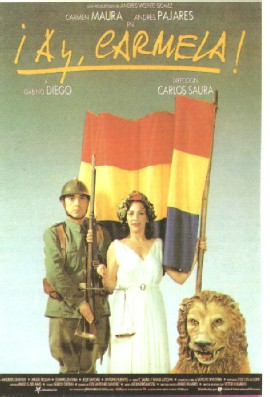
AY, CARAMBA! SPANISH MOVIES FOR FREE!


If you love Spanish films and don't know where to get your fix, the Instituto Cervantes has a regular film showing every Saturday ath the Salon de Actos in their new building along Kalaw St, Manila (besides the Casino Español). No charge, no questions asked. Just come early as seats are limited.